


The OpenVPX language for standardisation
OpenVPX defined new nomenclature for systems to describe the Gigabit serial links in terms of the number of lanes and their function. The term ‘pipe’ is used to define the number of bidirectional differential serial pairs that are grouped together to form a logical data channel. Pipe sizes range from one lane (1X) called an ‘ultrathin pipe’ or UTP, up to 32 lanes (32X) called an ‘octal fat pipe’ or OFP. The popular 4X link is called a ‘fat pipe’ or FP. OpenVPX also categorised the different kinds of traffic carried though the pipes as ‘planes’. The five planes defined are the utility, management, control, data and expansion planes.
In order to define architectural characteristics of systems, several ‘profiles’ were defined. A slot profile specifies the pipes and planes found on the backplane connectors of each slot. The module profile specifies the pipes, planes, fabrics and protocols implemented on each card. The backplane profile defines how the slots are connected to each other by pipes. And finally, the development chassis profile includes the backplane profile and defines the dimensions, power supply and cooling method.
VPX and VXS products
Dozens of embedded computer hardware vendors have developed numerous VXS and VPX products. These include backplanes; complete card cages and chassis; A/D and D/A converters; software radio cards; XMC carriers; single board computers; DSP and RISC array processors; FPGA cards and memory cards.
VXS fully supports PMC mezzanine modules and the Gigabit serial extension for PMC modules known as XMC. Both 3U and 6U VPX modules are also compatible with the Gigabit XMC interface. The enormous base of existing PMC and XMC I/O modules offers integrators many choices for their VXS and VPX application solutions.
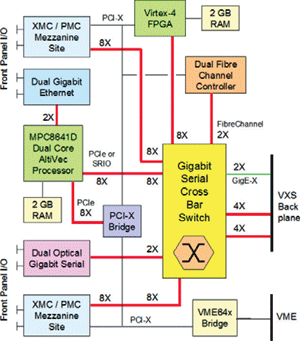
Integrators can immediately take advantage of a rich variety of offerings in the market. As an example, Figure 2 shows the Pentek Model 4207 VXS PowerPC I/O processor with dual XMC sites and a wealth of critical interfaces for high-performance embedded systems. At its heart is an onboard, fabric-transparent Gigabit serial crossbar switch. This switch highlights the vital role of serial technology for interconnecting resources within the board and to other boards across the backplane.
VPX applications
The latest embedded system designs show a definite shift towards serial fabric-based system architectures. These use both PCIe and SRIO, primarily to improve board-to-board data transfer rates that handle higher signal bandwidths, more powerful FPGAs and processors, and faster peripherals.
VPX cards in 3U and 6U sizes can support one or two XMC modules, respectively. Native PCIe and SRIO Gigabit serial interfaces on these XMCs are often directly compatible with processors, other devices on the carrier board, and also with VPX backplane control and data planes. Other XMC protocols like Xilinx Aurora are ideal for raw high-speed data links, often directly connectable to VPX data and expansion planes.
Because they deliver substantial performance benefits, the latest FPGAs and Gigabit serial fabrics increasingly dominate embedded system designs. Although these technologies are prevalent in both VXS and VPX platforms, VPX offers a clear advantage, not only because it offers many more links, but because it also simultaneously accommodates multiple protocols. For example, GigE can handle system management, while PCIe can be used for command and control. Serial RapidIO can support high-speed data transfer between processors, while Aurora can enable FPGAs to communicate raw data across the expansion plane.
Beam-forming systems for improved performance
Beam-forming applications use an array of antennas to improve directionality of reception and signal quality. The signal arrival delay at each antenna is based on the path distance from the source. The beam-forming process adjusts the gain and phase of each antenna signal to cancel the delay differences for signals arriving from a particular direction.
Aligned signals are summed together to produce high signal-to-noise reception in the chosen direction. By adjusting gain and phase in each path, the antenna is electronically ‘steered’ without the need for moving mechanical structures.
Examples of applications that use beam-forming include direction finding, where a beam-formed antenna can be steered to locate the arrival angle of a signal. Two or more arrays can be used to triangulate the exact location of the source. This is extremely important for signal intelligence and counter terrorism efforts.
Radar receiver applications use both one- and two-dimensional antenna designs for phased-array and SAR (synthetic aperture radar) systems. Electronic steering of the array dramatically improves the angular agility, range and target resolution of airborne antennas. Missile detection and countermeasure applications use beam-forming to improve tracking of an object for early detection and improved responsiveness. And lastly, beam-forming allows spatial frequency sharing by commercial mobile phone carriers because it divides the cell into several beam-formed sectors.
Figure 3 shows a 16-channel beam-former using four Pentek Model 5353 3U VPX boards. This digital beam-forming system takes advantage of the expansion plane for cascading beam-formed data between cards. Each of the four modules digitises four IF signals from four antennas in the array. Four DDCs (digital down-converters) translate the IF signals to baseband and perform beam-forming phase and gain adjustments.
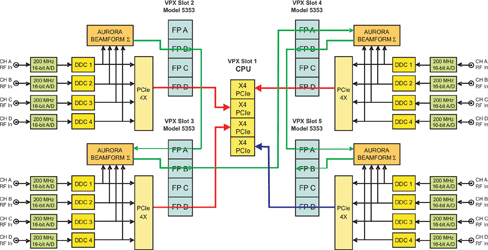
A summation engine accepts a propagated sum from a previous card, adds the four channels from the local card and then generates a new sum signal for delivery to the sum input of the next card in the chain. The summation paths use Aurora 4X Gigabit serial links for the expansion plane connections across the backplane.
VPX and VXS summary
While VPX systems can deliver aggregate transfer rates much higher than VXS, a vast majority of system requirements can be fully satisfied by the tremendous boost in rates that VXS offers over the legacy VME. Investments made by board vendors and system integrators in VXS hardware, interfaces, middleware, software and applications will translate easily into VPX, when system needs dictate.
With so many VPX-compatible products available today, and with the new OpenVPX VITA 65 standardisation, system integrators can feel confident selecting VPX architectures for high-performance embedded applications.
Further evidence that the industry has embraced VPX are two new extensions. The VITA 66 Fibre Optic Interconnect specification for VPX defines a family of fibre-optic interconnects that allows VPX connectors J2 though J6 to be replaced with optical connectors. The VITA 67 Coaxial Connector specification for VPX defines a shielded coaxial analog RF connector using the same mechanical dimensions as VITA 66. DRS Signal Solutions is leading the VITA 67 initiative and Pentek is actively teaming with DRS on specification acceptance and product development.
VPX dramatically improves embedded system performance and can achieve rates previously unattainable with earlier technology. For all of these very tangible considerations, VXS and VPX will dominate as the preferred architectures for future high-performance commercial and military embedded systems.
| Tel: | +27 21 975 8894 |
| Email: | sales@ri-tech.co.za |
| www: | www.ri-tech.co.za |
| Articles: | More information and articles about Rugged Interconnect Technologies |






© Technews Publishing (Pty) Ltd | All Rights Reserved
 printer friendly version